Have you ever wondered how those thick cables, whether they are delivering electricity to your home or connecting your company to the internet, are laid across rough and uneven terrain? They don’t just appear out of thin air! In this process, there’s an unassuming yet crucial piece of equipment at work, and that’s the cable conveyor. Today, let me tell you about this unsung hero and how it keeps our world “online” and “powered up”.
What is the cable conveyor
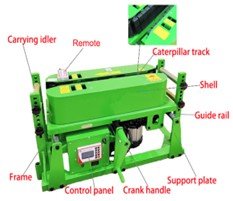
A cable conveyor (or a cable puller or cable laying machine) is a mechanical device specifically designed to lay, retrieve, or move cables in various complex environments. Imagine a cable that weighs several tons, which may need to pass through valleys, cross rivers, or even wind its way through dense underground pipelines in cities. Without a cable conveyor, this task would be nearly impossible.
Its main working principle is to use a roller or crawler system to “grab” the cable through friction, and then pull the cable forward or backward with strong power. It’s like giving the cable its own “legs”, allowing it to easily move along a preset path.
Why do we need the cable conveyor
You might be thinking, “It’s just pulling a cable—why make it so complicated?” Trust me, this is no trivial matter! The importance of cable conveyors is reflected in the following aspects:
Improving efficiency: Without cable conveyors, laying long-distance or large-diameter cables would require a huge amount of manual labor and take weeks or even months. With them, work efficiency is significantly enhanced, and some projects can even be completed in just a few days. Think about it—this not only saves time but also cuts down on substantial labor costs, doesn’t it?
Ensuring safety: Manually handling and laying heavy cables is extremely dangerous and prone to causing worker injuries. Cable conveyors automate most of the traction work, greatly reducing the risk of accidents at construction sites. According to data from the Occupational Safety and Health Administration (OSHA), the construction industry is one of the high-risk industries, and mechanized operations help reduce the risk factors associated with manual work.
Protecting cables: Cables themselves are expensive, especially fiber optic cables or high-voltage cables. Improper handling during laying can easily damage the cables, resulting in huge economic losses. Cable conveyors, with their precise tension control and stable traction, can minimize wear and damage to cables during transportation and laying.
Adapting to complex terrains: Whether it’s a muddy construction site, rugged mountain roads, or narrow underground pipelines, cable conveyors can handle them with ease. They are usually designed with strong off-road capabilities and flexible steering systems, enabling them to work in various harsh environments.
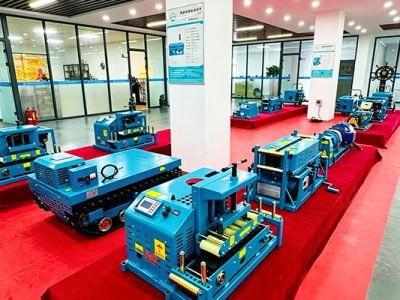
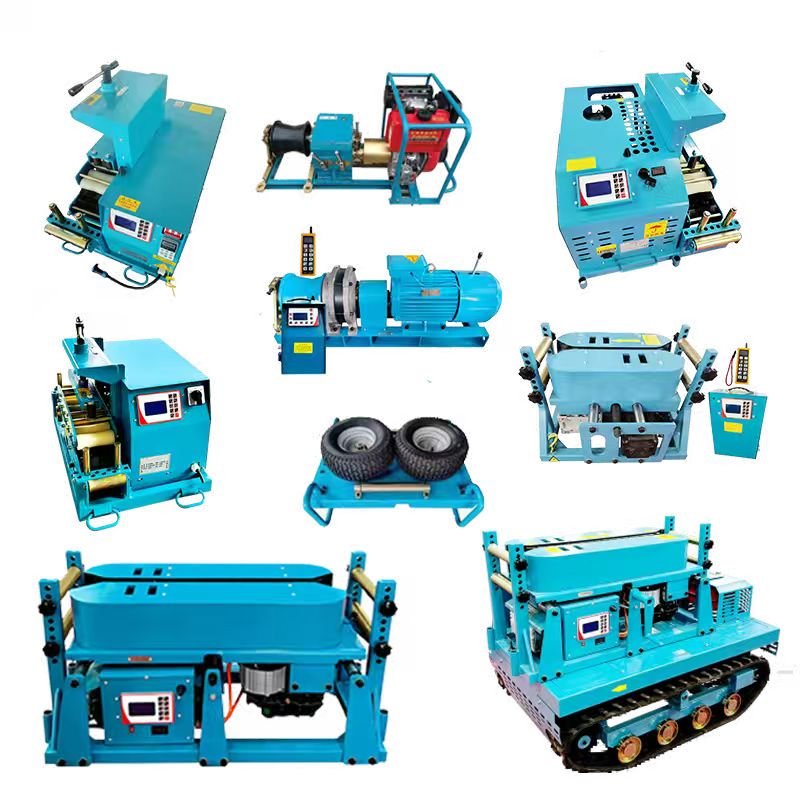
There are various types of cable conveyors available on the market, with different designs tailored to different application scenarios.
Electric cable conveyors: These conveyors are powered by electricity and are usually suitable for places with a stable power supply, such as factory premises, urban power grid renovation projects, or underground cable laying. Their advantages include low operating noise, zero emissions, and relatively simple maintenance. In construction sites with high environmental protection requirements, electric conveyors are the first choice.
Fuel-powered cable conveyors (gasoline or diesel): This is the most common type of cable conveyor, using gasoline or diesel engines as power sources. They have strong power and good mobility, making them ideal for operations in the wild, remote areas, or construction sites without a stable power supply, such as mountain power line erection and oil and gas pipeline laying. Their drawbacks are that they produce exhaust fumes and noise.
Cable conveyors with built-in generators: These conveyors usually combine a fuel engine with a generator, enabling them to provide electricity self-sufficiently. This means they not only have the strong power and independence of fuel-powered machines but also can supply electricity to themselves or small equipment when needed, increasing the flexibility of use. In some large and complex engineering projects, such conveyors with their own power generation capability can provide more reliable solutions.
Where to find reliable cable pulling equipment?
If you’re looking for high-performance, high-efficiency cable conveying solutions, or hoping to provide more professional services to your clients, Cabletug might just be what you need! We work closely with many experienced electrical contractors, committed to offering innovative and reliable cable pulling equipment to help them easily tackle various complex cable laying challenges.




 Spanish
  English
  Arabic
  Portuguese
  German
  Russian
  Korean
  Japanese